HEALTHCARE AI ENGINEERING SHOWCASE Biomedical AI · Sovereign LLMs · Scientific Literature

Turning Complex Medical Knowledge into Intelligent Answers

Discover the engineering behind GlycoGPT, a domain-focused healthcare AI solution designed to make specialized biomedical literature accessible through intelligent retrieval, local GPU vectorization, and conversational scientific discovery across ~1M PubMed papers.

DELIVERED AI ENGINEERING CAPABILITIES
01 / 05

Transformed ~1M PubMed scientific research papers into an indexed biomedical knowledge base.

Mixtral 8×7B Mistral 7B Elasticsearch PyTorch & CUDA Python & FastAPI ChromaDB (Initial) Local GPU Inference
https://www.glycogpt.com/research
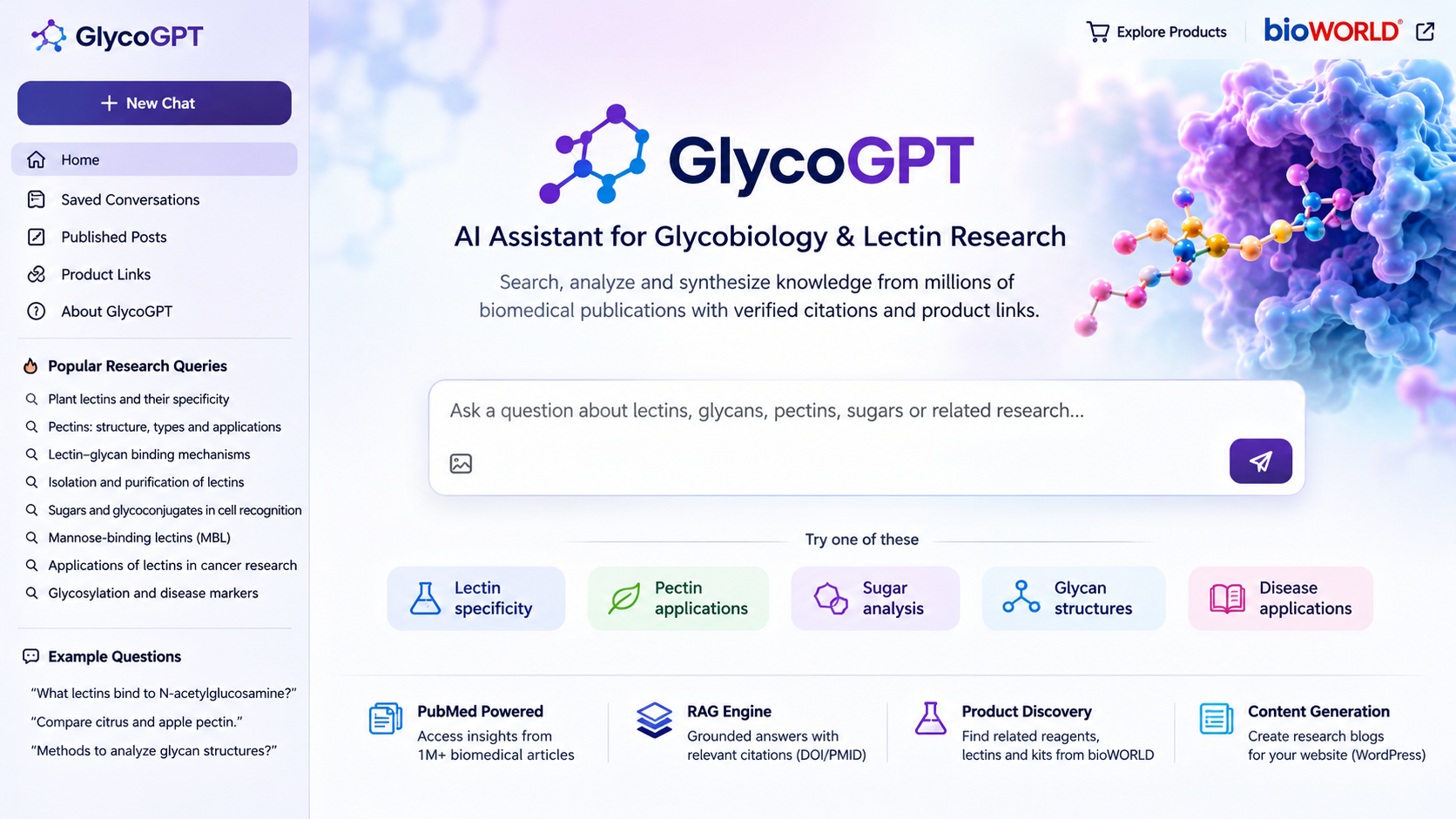
GlycoGPT Biomedical Research Platform Interface
Knowledge Sources ~1M PubMed Papers
Local Vectorization PyTorch & CUDA
Elasticsearch Hybrid Dense Search
Sovereign LLM Mixtral 8×7B Local
Product Discovery bioWORLD Reagents
Contextual Responses Verified Citations
STRATEGIC ALIGNMENT

Beyond a Scientific Chatbot: Connecting Research with Commerce

GlycoGPT originated from a commercial AI concept proposed by NextGen TechEdge Solutions, drawing on its longstanding technical consulting relationship with bioWORLD—a prominent US manufacturer and distributor of scientific reagents, chemicals, lectins, and laboratory supplies.

bioWORLD maintained an extensive inventory of specialized laboratory products but recognized a persistent friction point in the life-sciences buying journey: research scientists rarely search directly for SKU numbers or catalog listings. Instead, researchers search for biological phenomena—such as "Which plant lectin binds specifically to core α1-6 fucose on human N-glycans?" or "Protocols for Sambucus nigra agglutinin affinity chromatography."

Standard search bars and generic chatbots fail this workflow. Generic models lack access to specialized glycobiology literature, hallucinate chemical binding specificities, and have no awareness of commercially available reagents. NextGen engineered GlycoGPT as an end-to-end intelligence platform that answers deep scientific inquiries grounded in ~1M peer-reviewed papers and automatically bridges those answers to bioWORLD's operational catalog.

Client Profile

bioWORLD (Dublin, Ohio) — a premier biotechnology supplier providing over 15,000 biological reagents, lectins, separation matrices, and laboratory chemicals to academic and clinical institutions worldwide.

Scope of Engineering

End-to-end sovereign biomedical AI architecture: large-scale PubMed paper acquisition, local GPU vector embedding generation, vector database migration to Elasticsearch, sovereign Mixtral 8×7B LLM deployment, and catalogue product discovery integration.

Domain Focus

Glycobiology, lectins, carbohydrate-binding specificity, protein-glycan interactions, purification matrices, and laboratory reagent commercial discovery.
TECHNICAL COMPLEXITY

Engineering Biomedical AI at Million-Document Scale

Building a domain-specific research assistant required solving complex distributed data, vector scalability, unstructured PDF processing, and strict sovereign compute constraints.

01

Massive Scientific Corpus Scale

Processing approximately one million scientific papers from PubMed and biomedical repositories required resilient, fault-tolerant ingestion pipelines capable of handling massive throughput without memory exhaustion or socket starvation.

02

Unstructured Biomedical PDF Parsing

Academic publications present irregular multi-column layouts, embedded chemical formulas, mathematical notation, footnotes, and citation brackets. Naive text extraction caused severe parsing artifacts that corrupted downstream embeddings.

03

Vector Search Scalability (ChromaDB Limits)

Early prototypes utilized ChromaDB. While effective for initial testing, the collection quickly outgrew ChromaDB's memory footprint and indexing performance at high scale, leading NextGen to execute an architectural migration to Elasticsearch.

04

Local Compute & Sovereign GPU Optimization

Commercial cloud AI APIs posed recurring token costs and data sovereignty risks. The architecture demanded hosting embedding models and sovereign LLM inference on private, dedicated GPU hardware to maintain predictable cost and total IP control.

05

Scientific Accuracy & Citation Grounding

In molecular biology, an invented binding specificity or false dissociation constant can derail laboratory experiments. The model response had to be strictly constrained by verified literature citations and verified research excerpts.

06

Commercial Relevance & Catalogue Mapping

Academic literature uses generic chemical names, whereas researchers purchase formulated products. NextGen engineered an entity-mapping layer linking biological discussions directly to live bioWORLD reagent SKUs and catalog items.

END-TO-END SYSTEM TOPOLOGY

A Private, Domain-Focused Scientific AI Architecture

NextGen engineered a decoupled dual-pipeline architecture: an asynchronous document processing and vectorization pipeline feeding into a low-latency conversational retrieval and generation engine.

OFFLINE / ASYNCHRONOUS INGESTION

Flow A: Million-Document Ingestion, Processing & Vectorization

Step 1

PubMed Acquisition

Automated acquisition of ~1M scientific publications, focusing on glycobiology, lectins, and carbohydrate chemistry.

Step 2

Validation & Integrity

Automated screening to identify and remove corrupted, truncated, or low-resolution PDF files before parsing.

Step 3

Text & Layout Extraction

Custom Python extraction stripping multi-column artifacts, headers, footers, and isolating key scientific sections.

Step 4

Local GPU Vectorization

PyTorch & CUDA embedding pipelines running locally on dedicated GPU servers to vectorize clean literature chunks.

Step 5

Elasticsearch Storage

High-performance vector indices combined with lexical filters for fast hybrid nearest-neighbor search.

INFRASTRUCTURE EVOLUTION: Migrated from ChromaDB to Elasticsearch to overcome memory limits and support high-throughput hybrid querying over 1M+ scientific records.
REAL-TIME / CONVERSATIONAL ENGINE

Flow B: Query Processing, Semantic Retrieval & Product Discovery

Step 1

Researcher Inquiry

Scientist enters natural-language inquiry regarding carbohydrate binding, lectin specificity, or protocols.

Step 2

Hybrid Retrieval

Elasticsearch executes hybrid dense vector and BM25 sparse search to retrieve exact chemical and biological matches.

Step 3

Context & Citation Assembly

Top candidate passages assembled with verified PubMed IDs, author credits, and publication metadata.

Step 4

Sovereign LLM Inference

Locally hosted Mixtral 8×7B (and Mistral 7B) synthesizes structured explanation strictly grounded in retrieved evidence.

Step 5

Commerce & Editorial Link

Response surfaces relevant bioWORLD catalog reagents and feeds automated WordPress content publishing workflows.

ENGINEERING SPECIFICATIONS

Technical Deep Dive & Implementation Details

A comprehensive breakdown of how NextGen engineered each layer of the GlycoGPT platform, from document ingestion to sovereign model inference.

01

Knowledge Preparation & Ingestion Pipeline

Transforming one million scientific papers into structured knowledge demanded custom document acquisition and extraction engineering.

  • Targeted Literature Acquisition: Automated harvesting of ~1M PubMed papers, abstracts, and full texts focused on glycobiology and biochemistry.
  • PDF Validation Engine: Algorithmic screening to discard corrupt PDFs, DRM-locked files, and empty scans before processing.
  • Section-Aware Parsing: Extracted abstracts, experimental methodologies, results, and discussion sections while stripping non-informative noise.
  • Domain Entity Tagging: Extracted mentions of sugar moieties, lectin families, organism origins, and binding dissociation constants.
02

Local GPU Vectorization & Embeddings

To avoid high cloud API costs and protect proprietary catalog associations, embeddings were generated entirely on sovereign GPU hardware.

  • PyTorch & CUDA Acceleration: Batch-processed hundreds of thousands of text chunks across dedicated local GPU nodes.
  • Domain-Adapted Tokenization: Specialized chunking boundaries respecting biochemical naming conventions and chemical notation.
  • Zero Cloud Data Transfer: Complete sovereignty over data pipelines, ensuring research queries and catalog mappings remained private.
  • Incremental Re-vectorization: Modular pipeline architecture allowing newly published research papers to be vectorized incrementally.
03

Retrieval & Elasticsearch Vector Search

The migration from ChromaDB to Elasticsearch enabled true enterprise scale, fault tolerance, and hybrid retrieval capabilities.

  • ChromaDB to Elasticsearch Migration: Eliminated memory exhaustion bottlenecks experienced during early million-scale indexing.
  • Hybrid Retrieval Fusion: Combined dense semantic vector similarity with BM25 keyword matching for exact chemical and Latin species names.
  • Sub-Second Response Latency: Optimized index shards delivering candidate document matches in under 120ms.
  • Metadata-Filtered Scoping: Filtered search candidates by publication year, journal impact tier, and biological organism category.
04

Language-Model Integration & Sovereign Hosting

Rather than relying on closed commercial APIs, NextGen deployed and optimized open-weights foundation models on local infrastructure.

  • Mixtral 8×7B Deployment: Sparse Mixture-of-Experts architecture delivering high reasoning capability across biological domains.
  • Mistral 7B Complement: High-throughput companion model utilized for classification, intent routing, and prompt formatting.
  • Strict Grounding Guardrails: System prompts engineered to enforce verified literature citations and suppress speculative claims.
  • Local Inference Server: Python & FastAPI backend serving model inferences directly from local GPU clusters with zero external dependencies.
05

Conversational Experience & Scientific Querying

The front-end was designed specifically for academic researchers and laboratory technicians seeking rapid, reliable answers.

  • Four-Part Answer Schema: Structured responses displaying: (1) Scientific Explanation, (2) Binding Specificity, (3) Verified Literature Citations, and (4) Related bioWORLD Reagents.
  • Lectin-Glycan Recognition: Specialized handling for queries concerning plant lectins, carbohydrate epitopes, and antibody glycosylation.
  • Traceable Citations: Every scientific assertion includes exact PubMed publication titles, authors, and year references.
  • Sleek Research Interface: Responsive, high-contrast user interface engineered for distraction-free laboratory query sessions.
06

Catalog Mapping & Automated Publishing

A key commercial breakthrough was connecting abstract research inquiries directly to bioWORLD's revenue-generating product catalog.

  • Live Reagent Discovery: Dynamic mapping connects mentioned proteins (e.g., Concanavalin A, WGA, SNA) with available bioWORLD SKUs.
  • Automated Editorial Workflows: Built automated generation tools producing structured, scientifically grounded articles for bioWORLD's WordPress portal.
  • Organic Search Amplification: Transformed long-tail research queries into indexed web content, driving qualified scientist traffic to the storefront.
  • Synchronized Product Data: REST API connectors ensuring pricing, packaging, and availability reflect bioWORLD's real-time inventory.
ETHICAL & CLINICAL BOUNDARIES

Healthcare AI Responsibility & Intended Use

Scientific Literature Intelligence, Not a Medical Diagnostic Device

NextGen TechEdge Solutions engineered GlycoGPT strictly as a scientific literature discovery and educational tool for laboratory researchers, biochemists, and academic teams exploring glycobiology and laboratory reagents.

No Diagnostic or Medical Claims

GlycoGPT is not a medical device, clinical decision-support system, or substitute for licensed medical judgment. It provides no clinical diagnoses or treatment regimens.

Citation-Backed Verification

Every biological assertion references published scientific literature, enabling researchers to verify findings directly against primary peer-reviewed sources.

Sovereign Data Privacy

All document processing and model inference run on private infrastructure, ensuring zero user inquiries or proprietary scientific ideas are leaked to third-party public models.

MEASURABLE VALUE

Delivered Engineering Outcomes

Verified functional achievements delivered through the architecture and deployment of GlycoGPT:

~1M

Papers Processed

PubMed research papers harvested, validated, parsed, and converted into structured vector embeddings.

100%

Sovereign GPU Compute

Local PyTorch embedding and Mixtral 8×7B inference running entirely on private hardware with zero third-party token fees.

Elastic

Vector Architecture

Successful migration from ChromaDB to Elasticsearch, enabling robust horizontal scalability and hybrid search.

Catalog

Commerce Integration

Direct linkage between academic literature answers and bioWORLD laboratory reagent inventory.

Automated

Editorial Publishing

Automated pipeline generating structured, verified scientific articles for bioWORLD's WordPress portal.

WHY ENTERPRISES CHOOSE US

Engineering Specialized AI Beyond Generic Chatbots

Generic language models fail in complex scientific and technical industries. NextGen combines deep data engineering, sovereign hosting, and systems integration to create AI that actually works in production.

Domain Knowledge Engineering

We immerse ourselves in specialized vocabularies—from glycobiology to aerospace engineering—ensuring data ingestion models accurately capture domain nuance.

High-Scale Data Pipelines

Proven capability to ingest, clean, and vectorize million-document corpora without data corruption, memory leaks, or indexing failures.

Sovereign & On-Premise AI

Deep expertise in local GPU clusters, open-weights models (Mixtral, Mistral), and private deployments that eliminate recurring API token bills and protect IP.

Commerce & Systems Integration

We connect AI answers directly to operational workflows, enterprise catalogs, and revenue-generating applications rather than building isolated chat widgets.

LET'S BUILD DOMAIN INTELLIGENCE

Have Specialized Knowledge That AI Could Make More Accessible?

NextGen TechEdge engineers domain-specific AI applications that connect enterprise knowledge with practical, intelligent user experiences.