 Enlarge
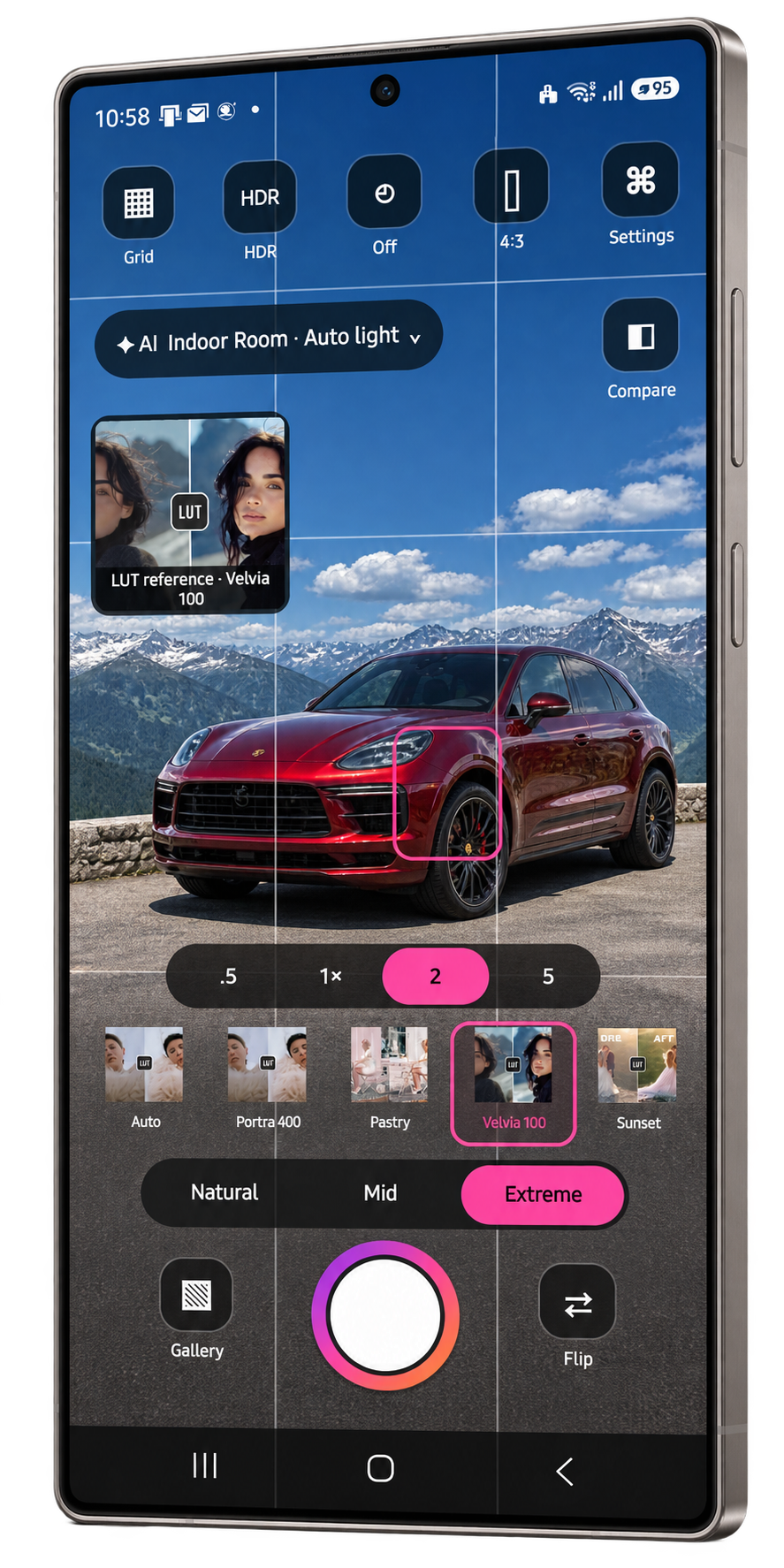
01 — Camera LUT portrait capture interface showing Extreme LUT preset framing and viewfinder controls.
Cinematic film grading with instant shutter return. Completely on your phone.
In-house product developed by NextGen TechEdge Solutions. Documented on physical target devices (Realme Pad RMP2204, Pixel 6a).
Modern smartphone photography frequently forces a compromise between aggressive stock computational HDR (which often produces flat, cartoonish contrast, harsh edges, and oversaturated skin) and complex desktop color grading suites. Camera LUT was engineered to bring film-quality color rendering, balanced dynamic range, and authentic photographic character directly to the Android capture experience without requiring post-processing roundtrips or cloud services.
Engineering a real-time camera application with 3D color grading on diverse Android hardware presents fundamental architectural hurdles. First, attempting live 3D LUT rendering or TextureView pixel polling on preview frames causes severe thermal throttling and viewfinder stutter on mid-range devices. Second, long post-processing latencies lock the camera UI, causing unacceptable shutter lag between consecutive shots. Third, naive color transformation in non-linear gamma space causes severe color banding, clipping, and posterization. The architecture required decoupled preview and capture pipelines that guarantee 30fps viewfinder fluidity while delivering studio-quality color grading in the background.
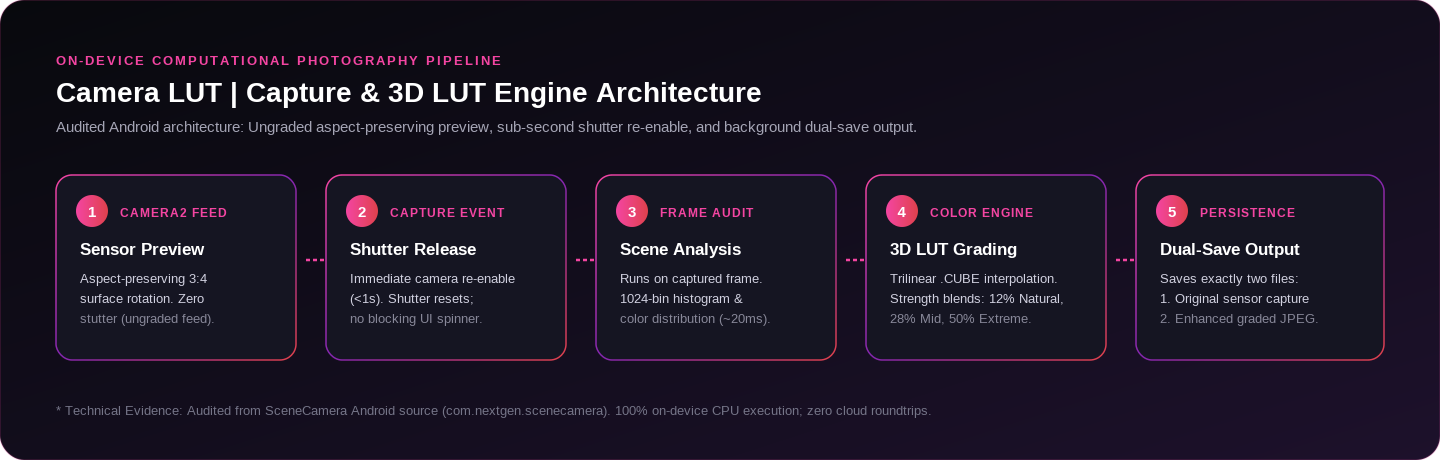
Camera LUT achieves high responsiveness and cinematic fidelity through an asynchronous decoupled architecture:
1. Decoupled Aspect-Preserving Preview: The Camera2 viewfinder feed is deliberately kept smooth and ungraded. The camera preview surface rotates directly to match the rear sensor's hardware-reported 90-degree orientation and performs aspect-preserving center cropping (3:4 ratio), completely eliminating non-uniform stretching without CPU pixel-copy polling.
2. Instant Sub-Second Shutter Re-Enable: When the user taps the shutter, the camera hardware acquires the full-resolution sensor JPEG. The shutter button re-enables in under one second (verified at 0.8s on Realme Pad), keeping the camera in an active shooting state while heavy grading executes asynchronously on background worker threads without modal spinners.
3. 3D .CUBE Parsing & Trilinear Interpolation: The grading engine parses industry-standard 3D .cube LUT tables (including bundled profiles Portra 400, Velvia 100, Sunset, Twilight, Soft Day, and Night Colors). Using trilinear interpolation across 3D RGB lattice points, it recalculates color mappings smoothly without digital posterization.
4. Calibrated Blend Profiles: To avoid artificial over-grading, LUT blend weights are calibrated to Natural (12%), Mid (28%), and Extreme (50%) alongside softened technical gray-balance adjustment, preserving authentic photographic texture and believable shadow roll-off.
5. Non-Destructive Dual-Save Output: Every capture writes exactly two files to device media storage: (1) The unaltered original sensor JPEG, and (2) The enhanced color-graded JPEG, guaranteeing that original camera data is never destroyed.
100% On-Device Capture and Processing. Camera LUT operates locally without uploading photos, camera streams, or telemetry to external servers.
All photo processing, histogram analysis, and 3D LUT application happen directly on the device CPU. Captured images are written directly to local media storage.
Genuine project captures and architecture documentation drawn directly from technical project records:
Enlarge
01 — Camera LUT portrait capture interface showing Extreme LUT preset framing and viewfinder controls.
 Enlarge
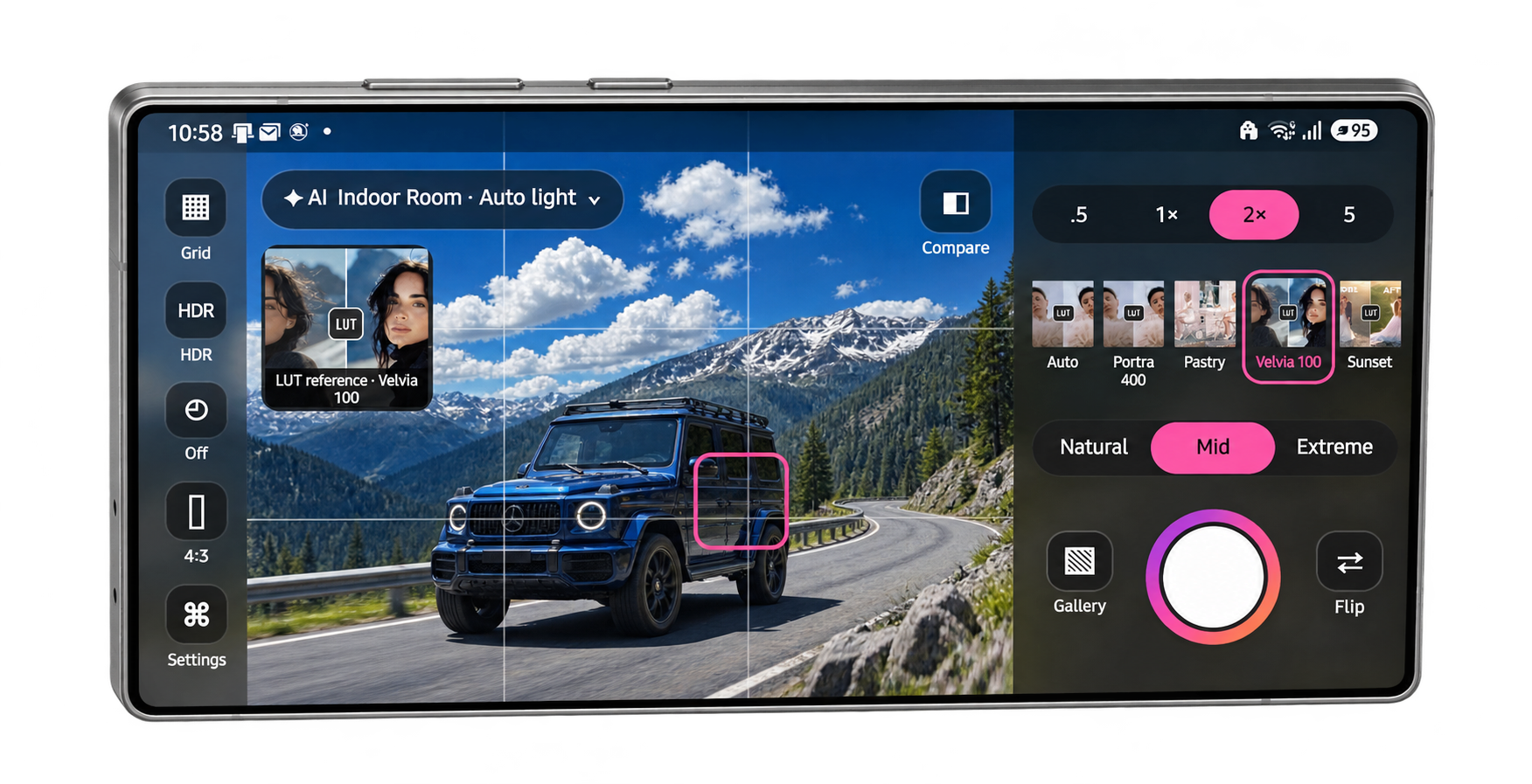
02 — Camera LUT landscape capture interface showing Mid strength grading and shutter controls.
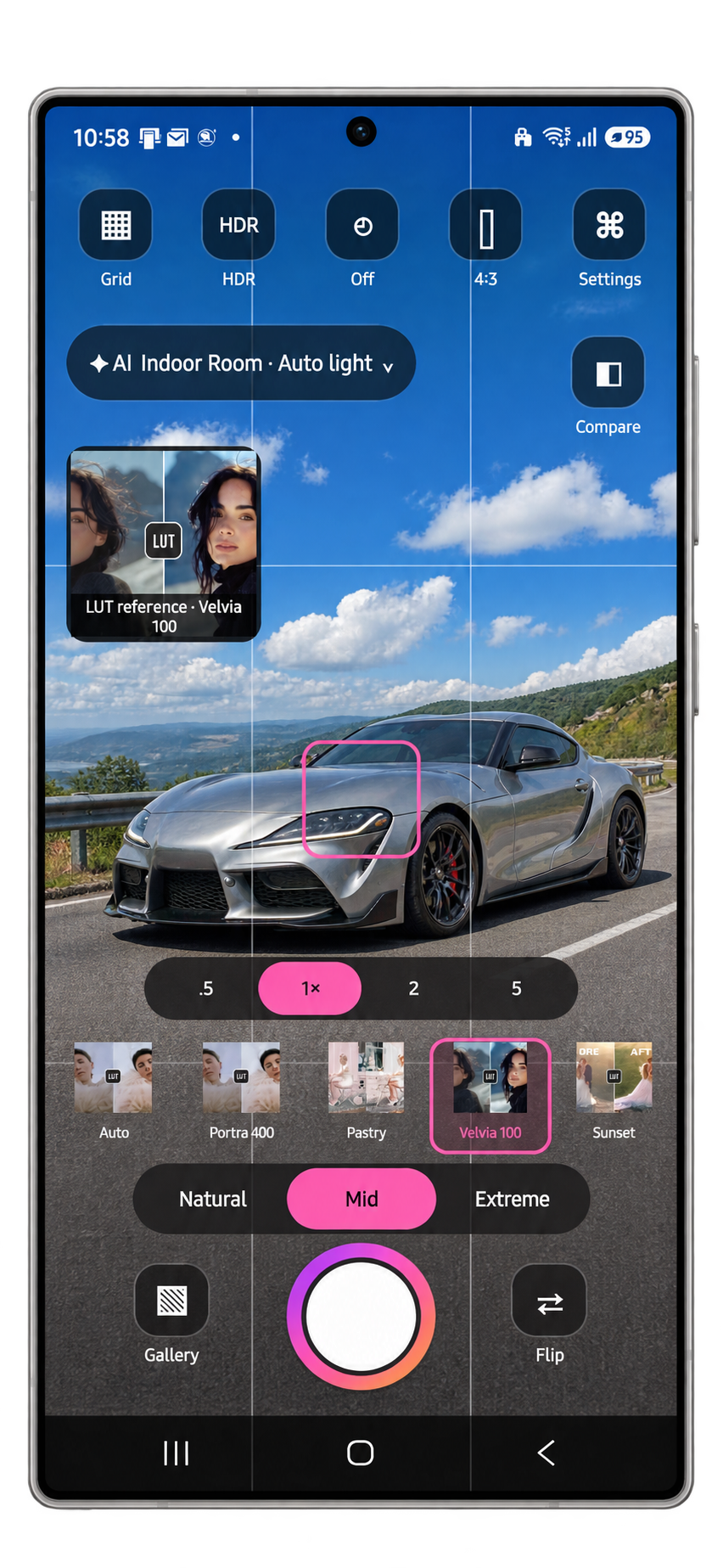 Enlarge
03 — Camera LUT portrait orientation showing Natural intensity profile and aspect-preserving framing.
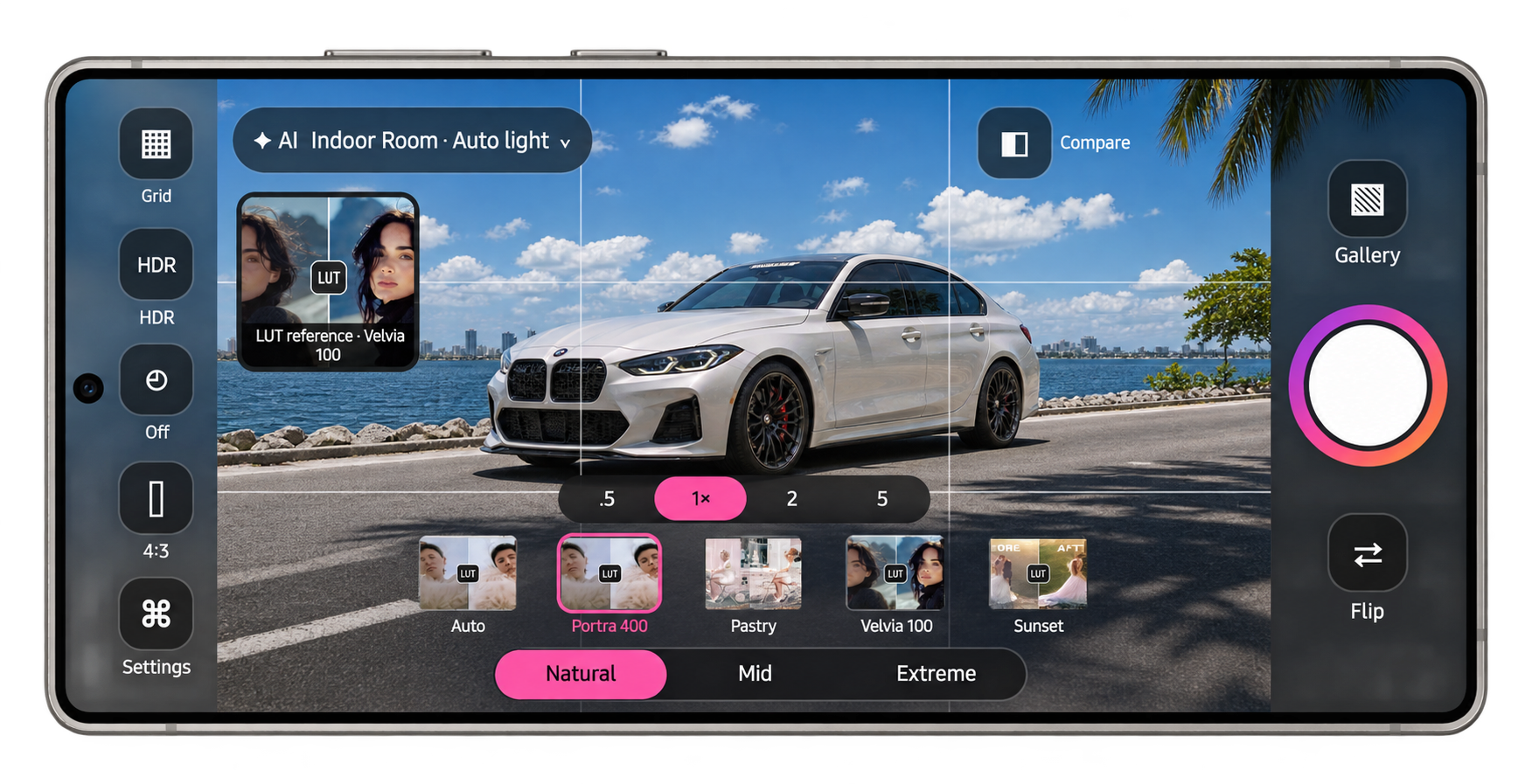 Enlarge
04 — Camera LUT landscape composition showing wide aspect framing and calibrated color balance.
Camera LUT was validated on physical Android hardware (Realme Pad RMP2204, MediaTek Helio G80 chipset, 3GB RAM). Automated UI instrumentation and logcat telemetry verified that the camera interface returns to active capture state in under 0.8 seconds post-shutter, while enhancement executes in the background (~20ms scene analysis, ~2.6s technical balance, ~6.2s 3D LUT render).
Documented technologies, frameworks, and protocols utilized across this domain:
Camera LUT is built as a native Android camera application prioritizing fluid viewfinder ergonomics, deterministic 3D color science, and strict sensor data preservation.
| Technology | Role / Component |
|---|---|
| Kotlin | Core camera pipeline, asynchronous coroutines, and background render orchestration |
| Android Camera2 API | Low-level camera device configuration, capture sessions, and aspect-ratio surface mapping |
| Jetpack Compose | Modern UI overlay for LUT selection, strength toggles, and shutter interaction |
| 3D .CUBE Parser | Parses industry-standard 3D LUT matrices into fast in-memory lookup lattices |
| Trilinear Interpolation | Smooth 3D RGB lattice interpolation preventing digital banding and harsh tonal steps |
| Dual-Save File Architecture | Concurrent file persistence for original sensor capture and graded output |
| Physical Instrumentation | Device profiling and timing validation on Realme Pad (Helio G80) and Pixel hardware |
Camera LUT demonstrates NextGen TechEdge Solutions' ability to build high-performance mobile camera applications with deterministic color science, responsive camera ergonomics, and reliable background rendering on real Android hardware.